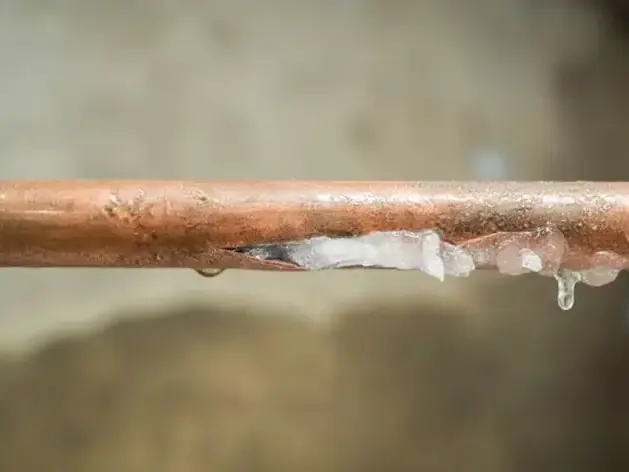
In Lake Stevens, frost can arrive from about early October and last into April. Homes built on raised floors have their supply pipes in vented crawl spaces, where a hard freeze reaches them. A pipe that freezes often splits quietly and shows the damage only when it thaws, which is how frozen pipe water damage usually starts.
Key takeaways
- Frost can reach Lake Stevens from about early October into April, so the first cold nights are the time to check pipes.
- Raised floors put supply pipes in vented crawl spaces, where a hard freeze can reach them.
- A frozen pipe often splits and leaks only after it thaws, so water can appear after the cold has passed.
- Close the main valve at the first sign of a split, then call a plumber for the pipe and a drying crew for the water.
- The January 2024 cold snap burst pipes across Snohomish County, a reminder that a hard freeze can reach this area.
Why pipes freeze in Lake Stevens homes
Raised floors and vented crawl spaces
Homes built on raised floors have their supply pipes under the floor, in a vented crawl space where cold air can move through.
A hard freeze that reaches the crawl space reaches the pipes. Pipes near vents, in unheated garages or in outside walls are the first to freeze, because cold air reaches them first.
When frost arrives
Frost can arrive any time from about early October and into April. The first cold nights of the season are usually the ones that catch a house unprepared.
A pipe that was never cold before can freeze on the first hard night, since nothing has tested it since last winter.
Signs that a pipe has frozen
Some signs show up while the pipe is still frozen. The costly one shows up after, because a pipe that split while frozen can look fine until the ice melts.
- A faucet that runs slowly or not at all, often on one fixture or one side of the house
- One fixture affected while the rest of the house runs normally, which points to the pipe that serves that fixture
- Frost or ice on an exposed pipe in the crawl space or garage
- A bulge or a crack in a pipe
- Unusual sounds when the water is turned on
- A damp patch on a ceiling, wall or floor after the temperature rises
What to do at the first sign
Act before the thaw, because a pipe that has split will start to leak as soon as the ice melts, and a burst pipe loss can follow.
- Close the main water valve.
- Open the faucet on the frozen pipe so melting water and trapped pressure have somewhere to go, and so the return of flow shows.
- Warm the area gently with a safely placed space heater or a hair dryer, and never use an open flame or a torch.
- Look in from the crawl space access door for wet insulation or standing water.
- Photograph any ice, splits or wet areas before repairs begin.
- Call a plumber for the pipe and a restoration crew for the water.
After the thaw: finding the split
When a frozen pipe thaws, water can pour from the split into the crawl space, a wall or the ceiling below. The leak may be hidden, so the main valve should stay closed until the pipe is found.
Many splits are small and weep for days, and a slow, steady drip can still soak insulation and framing.
A moisture meter and a thermal camera trace where the water went, and the repair opens only the wet cavities.
Where thawed water lands
- In the crawl space: wets the insulation, the vapor barrier and the joists.
- In a wall: wets drywall and insulation from the inside out.
- On a garage floor: spreads toward the house and stored items.
- In a ceiling below an upstairs bath or laundry: stains, sagging drywall and drips.
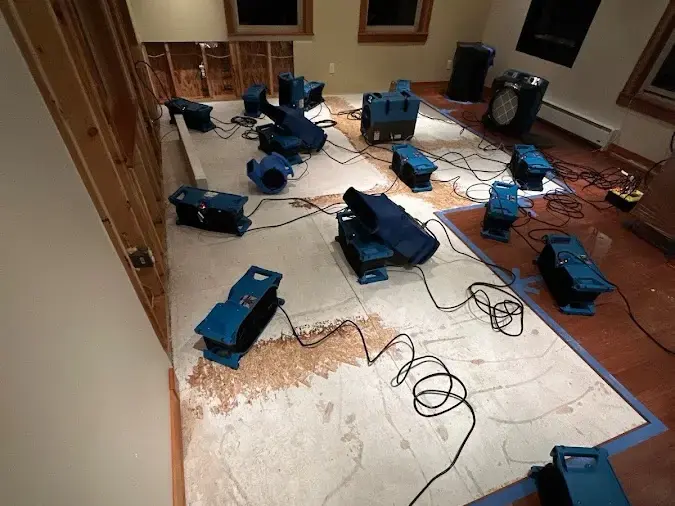
Cleanup: extraction, the crawl space and drying
Water extraction removes standing water first. In a crawl space, that means pumping, removing soaked insulation and a torn vapor barrier, and drying the joists.
A tight crawl space limits where equipment can go, so hoses and air movers are run from the access door and the work is planned around wiring and ducts.
The same crew then dries wet walls and floors with air movers and dehumidifiers, and logs daily readings until they match a dry reference. For water under the floor, see crawl space water removal.
A split pipe is a plumbing repair, and the water damage is a separate job, so the loss needs both trades, one for the pipe and one for the damage.
What the crew removes
- Soaked insulation in the crawl space
- A torn or flooded vapor barrier
- Wet drywall at the base of a wall
- Flooring that has lifted or swelled
The January 2024 cold snap
A January 2024 cold snap burst pipes across Snohomish County.
Lake Stevens gets about 39 inches of rain a year, and cold is not the usual story. The cold snap showed that a hard freeze can still happen here.
Frost nights come with the season, so the real question is how long the cold lasts and whether the pipes are protected. A single hard night can be enough to split an unprotected pipe.
Protecting pipes before the next freeze
A few small jobs before the first frost cost far less than a split pipe, and most of them need only a few supplies and no contractor.
- Insulate exposed supply pipes in the crawl space, garage and outside walls.
- Disconnect garden hoses and shut off outdoor spigots before the first frost.
- Know where the main valve is, and make sure it turns.
- On a hard freeze night, open cabinet doors on outside walls and let a faucet drip.
- Check the crawl space vents and the access door for gaps.
- Keep the garage door closed on freezing nights if supply pipes run through the garage.
Questions
When does frost start in Lake Stevens?
Frost can arrive any time from about early October into April. The first cold nights are the ones to prepare for.
Why do pipes split after the thaw instead of while frozen?
Ice blocks the pipe and builds pressure, and the split opens while the pipe is frozen. The water cannot escape until the ice melts, so the leak shows up on the thaw.
Should the water be shut off if a pipe is frozen but not leaking?
Closing the main valve is a cautious step. The pipe can be thawed slowly, and any split will show when water moves again.
Does homeowners insurance cover a burst pipe?
Many policies cover sudden pipe damage, but coverage depends on the policy and the cause. Check the wording or ask the insurer.
Why are crawl space pipes at risk?
Raised floors put supply pipes in vented crawl spaces, where a hard freeze reaches them. Cold air moves through the vents, so the pipes are close to outdoor temperatures.
How long does drying take after a pipe bursts in a crawl space?
It depends on how much water reached the insulation, the joists and the floor above. The equipment stays until readings match a dry reference.